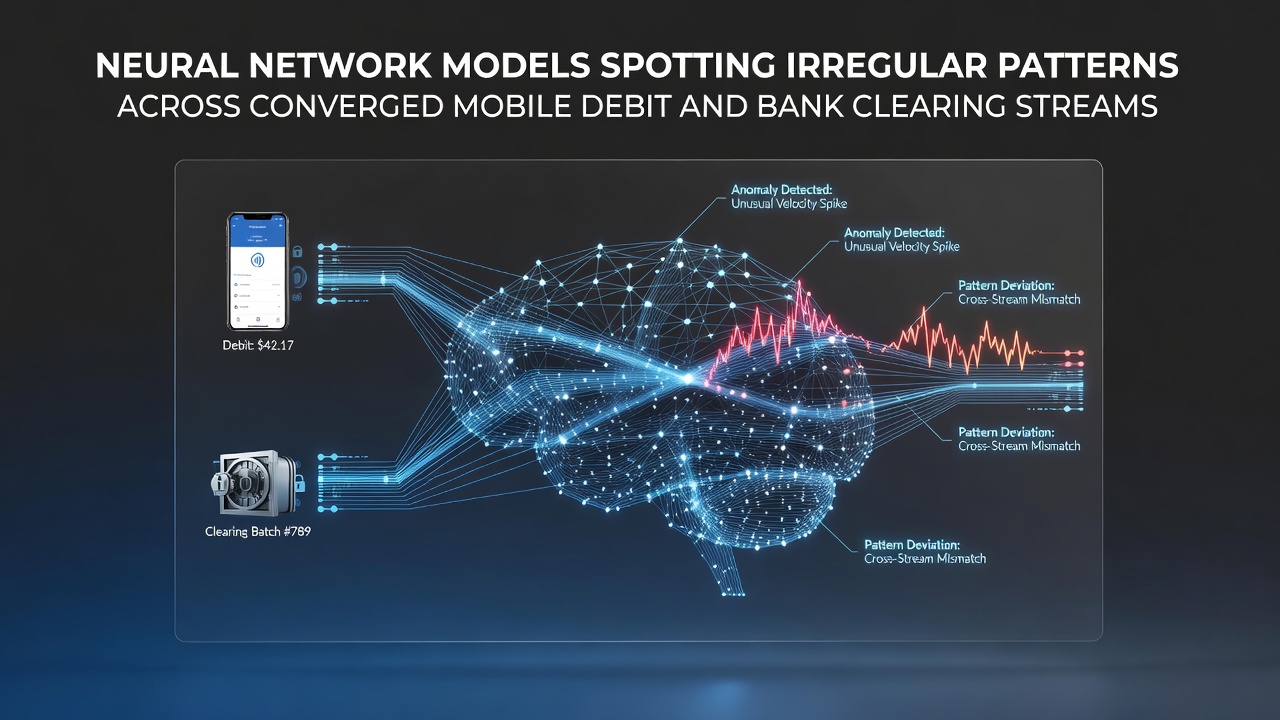
Neural Network Models Spotting Irregular Patterns Across Converged Mobile Debit and Bank Clearing Streams
Financial institutions have integrated mobile debit transactions with traditional bank clearing streams over the past decade, creating unified data environments where neural network models now monitor activity for anomalies in real time. These systems process high volumes of payments that originate on smartphones and route through automated clearing houses, and the convergence allows algorithms to examine sequences that span both channels without manual intervention.
Convergence of Mobile Debit and Bank Clearing Data
Mobile debit streams carry details such as device identifiers, geolocation timestamps, and instant authorization requests, while bank clearing protocols add settlement codes, account routing numbers, and batch processing records. When these datasets merge, patterns that previously appeared isolated become visible across the full transaction lifecycle. Researchers at academic centers have documented how combined datasets improve detection rates for authorization mismatches that occur when a mobile-initiated debit fails to align with subsequent clearing entries.
Payment processors began testing unified pipelines in 2024, and by July 2026 several large networks reported full operational deployment across multiple regions. The resulting data flows now feed directly into neural architectures that treat each payment as a time-series event rather than a discrete record.
Neural Architectures Applied to Payment Streams
Recurrent neural networks and transformer-based models dominate current implementations because they handle sequential dependencies across mobile initiation and bank settlement stages. Long short-term memory layers capture temporal gaps between authorization and clearing, while attention mechanisms highlight unusual pairings such as rapid successive debits from the same device that clear through unrelated bank identifiers.
Convolutional components sometimes preprocess raw feature matrices derived from transaction amounts, frequencies, and merchant categories, converting them into representations that downstream layers classify as regular or irregular. Training datasets incorporate labeled examples from historical fraud cases along with synthetic anomalies generated to simulate emerging attack vectors.
Irregular Pattern Detection Mechanisms
Models flag deviations including velocity spikes that exceed established baselines for specific account profiles, geographic inconsistencies where a mobile debit originates in one jurisdiction yet clears through a bank branch registered in another, and timing anomalies such as clearing entries that appear hours after mobile authorization without corresponding network latency explanations. Graph neural networks further map relationships between accounts, devices, and counterparties to surface coordinated activity that spans multiple mobile sessions and clearing batches.

One documented case involved a series of low-value mobile debits that individually passed initial screening yet aggregated into clearing batches routed through accounts flagged for prior compliance reviews. The neural system identified the clustering before settlement completed, allowing operators to pause the batch for additional verification.
Integration with Compliance Frameworks
Regulatory bodies require audit trails that link model decisions to specific transaction attributes, and payment platforms have embedded explainability modules that output feature importance scores alongside each alert. According to guidance from the Federal Reserve, such documentation supports examiner review of automated monitoring controls. In parallel, the European Central Bank has outlined expectations for model validation procedures that cover cross-border data streams involving mobile and clearing channels.
Operators update model parameters on rolling schedules that incorporate new clearing formats introduced by network rule changes, and performance metrics track both detection precision and the volume of false positives routed to human review queues.
Operational Outcomes Reported Through Mid-2026
Industry reports compiled in the first half of 2026 indicate that institutions running converged-stream models recorded measurable reductions in post-settlement adjustments compared with prior segmented monitoring approaches. The improvements stem from earlier identification of mismatches that previously surfaced only after funds moved between institutions. Training cycles now draw on expanded feature sets that include device fingerprint stability and clearing code consistency, allowing models to adapt to seasonal variations in transaction volume without manual recalibration.
Conclusion
Neural network models continue to evolve alongside the technical integration of mobile debit and bank clearing infrastructures, with ongoing work focused on handling new data formats and regulatory reporting requirements. Institutions maintain separate validation datasets to confirm that performance observed in production aligns with results from controlled testing environments.