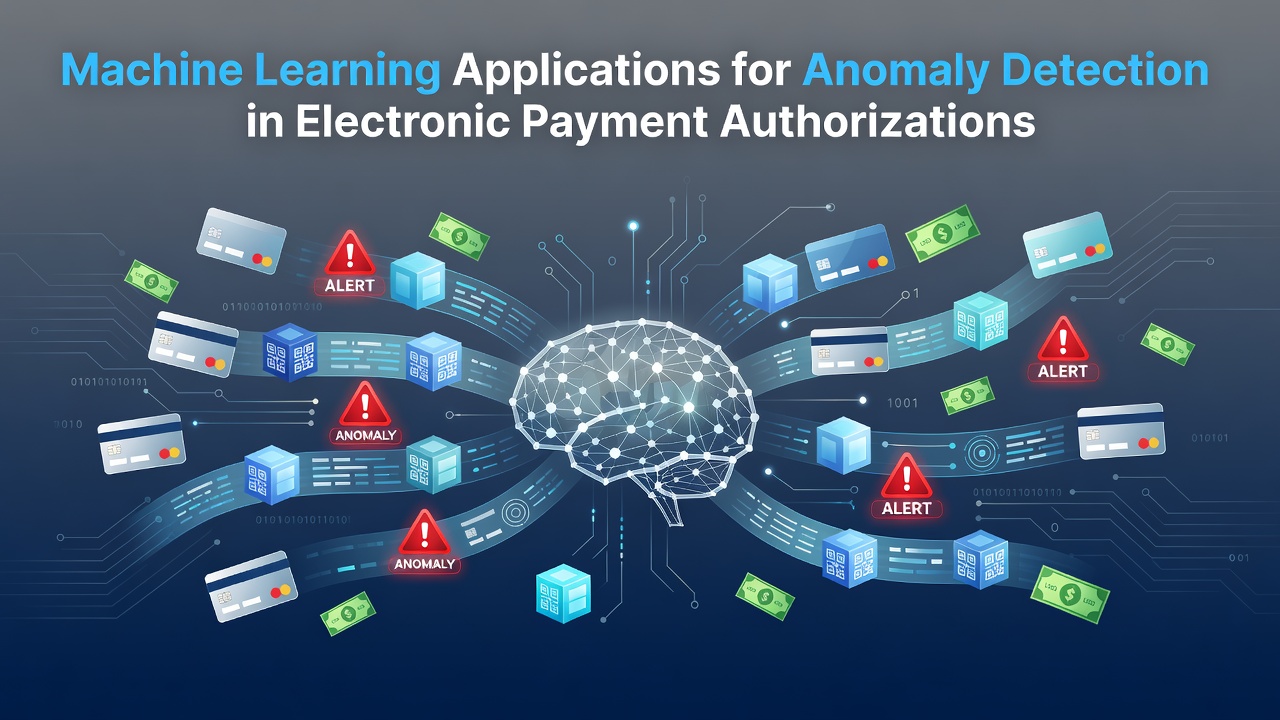
Machine Learning Applications for Anomaly Detection in Electronic Payment Authorizations
Electronic payment authorizations generate vast streams of transaction data every second, and machine learning systems now sift through those streams to flag anomalies before funds move. These systems examine variables such as transaction amount, merchant category, device fingerprint, geographic location, and authorization velocity, then compare each new request against learned baselines of normal behavior. When a request deviates sharply from established patterns, the model assigns a risk score that can trigger a decline, a step-up authentication challenge, or manual review.
Core Machine Learning Techniques in Use
Supervised learning models train on historical labeled datasets where transactions have already been marked as legitimate or fraudulent, allowing algorithms such as gradient-boosted trees and deep neural networks to learn decision boundaries that separate the two classes. Unsupervised approaches, including isolation forests and autoencoders, operate without labels by identifying instances that appear statistically rare within the broader data distribution. Semi-supervised methods combine small amounts of labeled data with large volumes of unlabeled authorizations to improve detection when fraud labels are scarce or delayed.
Researchers at institutions across North America and Europe have documented how ensemble methods that blend multiple models often outperform single-algorithm approaches because they reduce false positives while maintaining high recall on genuine fraud attempts. Feature engineering remains central: derived variables such as time since last transaction, ratio of current amount to average spend, and mismatch between billing and shipping addresses frequently rank among the strongest predictors.
Deployment Patterns Across Payment Networks
Issuers and acquirers integrate these models into real-time authorization pipelines that must return decisions within milliseconds. A typical flow begins with data ingestion from the point-of-sale terminal or mobile wallet, followed by enrichment with external signals such as device reputation lists and velocity counters stored in distributed caches. The enriched feature vector then passes through the trained model, which outputs a probability or anomaly score; rules engines apply thresholds that can vary by merchant segment or card product.
In June 2026, several large processors reported expanding their model retraining cycles from monthly to weekly intervals to keep pace with evolving fraud tactics, while maintaining compliance with data-residency requirements in multiple jurisdictions. Cloud-based inference endpoints now handle peak authorization loads during holiday shopping periods without introducing measurable latency beyond baseline network delays.

Performance Metrics and Validation Practices
Industry reports track precision, recall, and area under the ROC curve as primary indicators, yet practitioners also monitor operational metrics such as the percentage of transactions routed to manual review and the average time to decision. Cross-validation on time-series splits prevents leakage from future fraud patterns into training data, a requirement emphasized in guidance from regulatory bodies including the European Central Bank. Back-testing against historical attack campaigns helps confirm that models would have caught known breaches without excessive friction on legitimate customers.
One documented case involved a North American issuer that reduced fraud losses by more than 30 percent after deploying an isolation-forest model tuned on authorization logs spanning two years, while another European acquirer reported a 22 percent drop in false-positive declines after switching from rule-based systems to gradient-boosted ensembles. These outcomes emerged only after iterative feature selection and threshold calibration conducted over multiple quarters.
Integration with Existing Compliance Frameworks
Machine learning outputs feed into broader risk-management programs that satisfy requirements set by card networks and national regulators. Audit trails capture model version, input features, and score at the moment of each decision, enabling examiners to reconstruct why a particular authorization received elevated scrutiny. Data-protection statutes in various regions further require that personal information used for training remains anonymized or aggregated where feasible, prompting adoption of federated learning techniques that keep raw transaction records within their original jurisdictions.
Organizations also maintain human oversight layers; data scientists periodically review clusters of flagged transactions to identify emerging patterns that warrant new features or model updates. This feedback loop has proven essential because fraudsters adapt quickly, testing authorization systems with low-value probes before executing larger attacks.
Emerging Developments Through Mid-2026
Graph neural networks that model relationships between accounts, devices, and merchants have moved from research prototypes into production at several major processors, capturing coordinated fraud rings that evade simpler statistical checks. Reinforcement-learning agents that dynamically adjust scoring thresholds based on real-time fraud prevalence are under pilot evaluation, while explainability tools such as SHAP values now accompany many production scores to satisfy internal governance and external audit demands. Continued growth in contactless and account-to-account payments continues to expand the feature space available for anomaly detection, requiring ongoing investment in both infrastructure and talent.
Conclusion
Machine learning has become integral to the authorization layer of electronic payments because it processes high-velocity data streams at speeds and scales unattainable by manual review or static rules alone. The combination of supervised, unsupervised, and emerging graph-based techniques allows issuers and acquirers to maintain security while supporting the volume and speed expectations of modern commerce. Ongoing refinement of these systems, coupled with rigorous validation and compliance practices, continues to shape how payment networks distinguish legitimate transactions from anomalies.