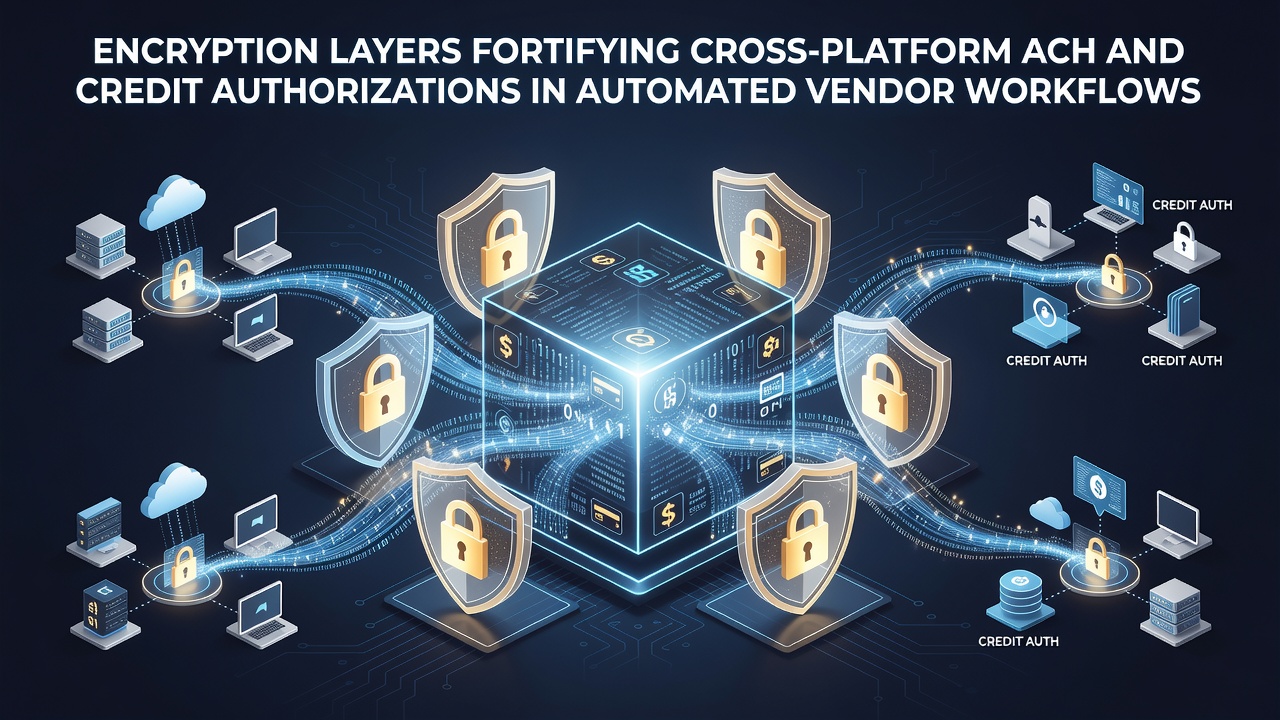
Encryption Layers Fortifying Cross-Platform ACH and Credit Authorizations in Automated Vendor Workflows
Automated vendor workflows rely on seamless movement of funds through ACH transfers and credit card authorizations that span web portals, mobile applications, and enterprise resource systems. Encryption forms the backbone that protects these transactions from interception while data travels between banks, processors, and merchant platforms. Standards bodies track adoption rates of layered encryption protocols that combine symmetric and asymmetric methods to secure both batch ACH files and real-time credit requests.
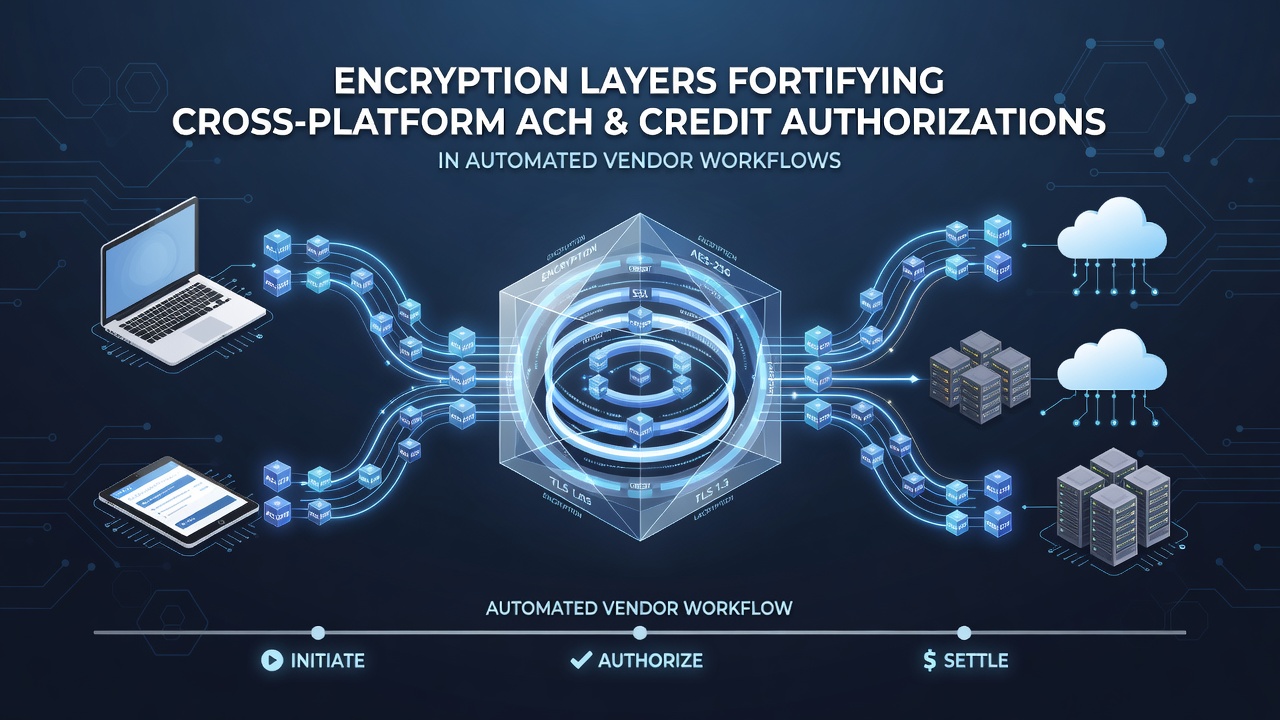
Payment networks process billions of ACH entries each year, and credit authorizations add another layer of volume that requires immediate verification. Multiple encryption stages operate at the transport level with TLS 1.3, at the application level with AES-256, and at the token level through format-preserving encryption. Researchers at the National Institute of Standards and Technology have documented how these combined layers reduce exposure windows during cross-platform handoffs.
Core Encryption Mechanisms in ACH Processing
ACH files move through the Federal Reserve and EPN networks where file-level encryption protects batch transmissions that contain routing numbers, account details, and remittance data. Organizations apply PGP or AES encryption to files before they reach the clearing house, while separate key management systems rotate credentials on scheduled intervals. Credit authorizations follow different paths that use point-to-point encryption from the point of capture through the acquiring bank.
Tokenization replaces sensitive card or account data with surrogate values that carry no intrinsic meaning outside the issuer environment. This substitution happens early in the workflow so that downstream vendor systems never store actual credentials. As of June 2026, updated PCI DSS guidance emphasizes maintaining separate encryption domains for ACH and credit channels even when they converge inside the same orchestration platform.
Cross-Platform Integration Challenges
Vendor management systems often connect legacy ERP modules with modern cloud APIs, creating multiple data exchange points that each require encryption enforcement. Mobile applications introduce additional variables because device operating systems handle cryptographic operations differently than desktop browsers. Developers implement hardware security modules and secure enclaves to isolate key material from the main application process.
Data shows that consistent policy enforcement across platforms reduces authorization failures linked to decryption errors. Observers note that organizations using unified key orchestration services report fewer reconciliation issues between ACH returns and credit reversals. The European Payments Council published findings in 2025 that highlighted similar patterns across cross-border vendor networks operating under SEPA and card schemes.
Compliance and Key Management Practices
Regulatory frameworks require documented procedures for key generation, distribution, storage, and destruction. Automated vendor platforms integrate with hardware security modules that perform cryptographic operations without exposing keys to application memory. Audit logs capture every key access event, which supports both internal reviews and external assessments required under payment card standards.
PCI Security Standards Council documentation outlines requirements for protecting cardholder data throughout its lifecycle, while ACH security relies on NACHA operating rules that address file encryption and access controls. Organizations that maintain separate encryption policies for each channel yet share a centralized key management service achieve both compliance and operational efficiency.
Operational Impact on Vendor Cycles
Encryption overhead introduces measurable latency that vendors must account for during peak processing windows. Optimized implementations use session caching and hardware acceleration to keep authorization times within acceptable thresholds. Studies from academic institutions tracking payment processing metrics indicate that well-tuned encryption layers add less than 50 milliseconds to typical transaction paths when implemented correctly.
Vendor dashboards display real-time status of encrypted connections and flag any certificate or key rotation events that could interrupt workflows. Automated alerts trigger when transport layer security versions fall below current minimums, allowing teams to update configurations before authorization volumes increase.
Conclusion
Encryption layers continue to evolve alongside changes in ACH and credit authorization protocols that support automated vendor workflows. Consistent application of transport, application, and token-level protections across platforms maintains data integrity while meeting regulatory expectations. Organizations that align their encryption strategies with documented standards and maintain rigorous key management practices position their payment operations for sustained reliability as transaction volumes grow through 2026 and beyond.